


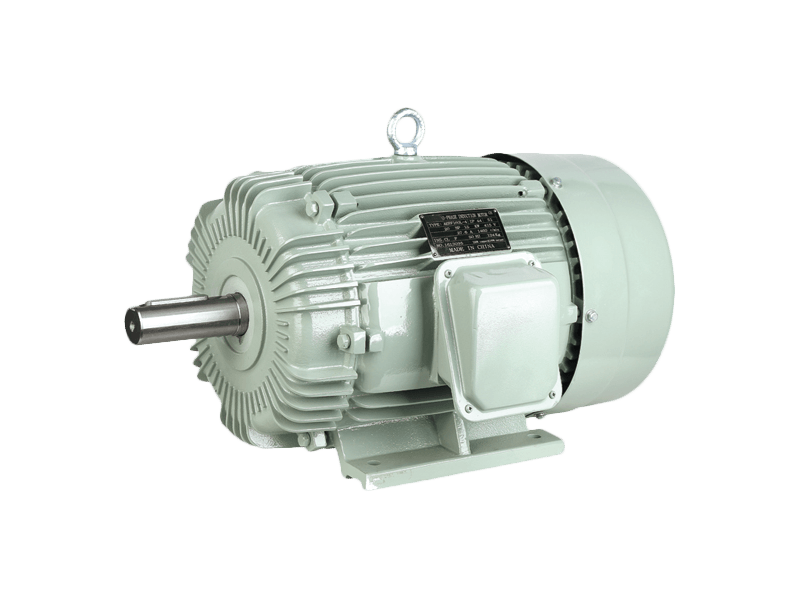
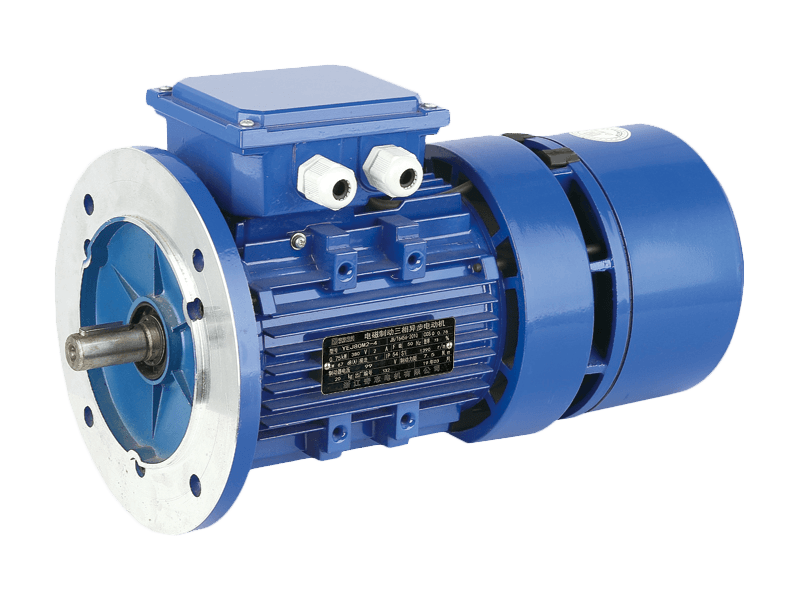
A Three-Phase Asynchronous Motor wound for 50 Hz and run on a 60 Hz supply does not behave like the same motor at a different speed. Synchronous speed follows 120 times frequency divided by pole count, so a 4-pole machine turns its field at 1,500 rpm on 50 Hz and 1,800 rpm on 60 Hz. With slip of around 3 to 5 percent, rated shaft speed lands near 1,450 rpm in one case and 1,750 rpm in the other. The same 20 percent gap applies at other pole counts, from 3,000 and 3,600 rpm for a 2-pole machine to 1,000 and 1,200 rpm for a 6-pole one. Every sizing question on an export order starts from it.
For a fan or centrifugal pump coupled directly to the shaft, load power rises with the cube of speed, and 1.2 cubed is 1.73. A Three-Phase Asynchronous Motor chosen at 90 percent load on a 50 Hz grid would be asked for roughly 155 percent after the move to 60 Hz. It overheats long before the nameplate rating is reached.
Conveyors, screw compressors and positive-displacement pumps behave differently. Their torque stays close to constant, so power rises about 20 percent, and a motor with some margin can carry that. Same frame size, two loads, two outcomes. Equipment makers ask for the load type before they quote.
Magnetic flux in the core depends on the volts-per-hertz ratio. 400 V at 50 Hz gives 8.0, and holding 8.0 at 60 Hz takes 480 V. Many 60 Hz markets run 460 V, a ratio of 7.7, so the winding is designed around that figure.
Feed a 400 V motor at 60 Hz without changing the voltage and the ratio drops to 6.7. Torque capacity follows the square of that ratio, which leaves about 69 percent of the original breakdown torque. A Three-Phase Asynchronous Motor that has to start a loaded machine shows the loss at start-up, when the shaft hesitates or stalls on a full hopper or a loaded belt.
Rated speed is not fixed by power and pole count alone. Two 4-pole motors of the same kilowatt rating from different suppliers can differ by 20 to 30 rpm, because slip depends on rotor design. On a pump, 30 rpm out of 1,450 is about 2 percent in speed, which shows up as roughly 4 percent in head and 6 percent in power draw. Buyers who compare a Three-Phase Asynchronous Motor from two sources therefore read the rated speed line on the datasheet next to the kilowatt figure, since a pump curve is plotted against shaft speed and not against nameplate power.
An 11 kW, 4-pole Three-Phase Asynchronous Motor at 400 V draws about 21 A at rated load. A direct-on-line start pulls 6 to 7 times that, around 125 to 145 A for a moment. Installers size the breaker curve and the cable from the peak figure, not from 21 A, and on a long cable run the voltage drop at start-up pulls starting torque down further.
Star-delta starters cut the line current to about one third of the direct figure, which explains why larger motors ship with six terminals in the box. Wired in star at 400 V or delta at 230 V, the same Three-Phase Asynchronous Motor can serve two supply voltages, and the terminal plate shows which link arrangement belongs to which.
Search traffic for a Three-Phase Asynchronous Motor from overseas buyers often carries these questions inside it. Does the nameplate list both frequencies, with rated speed and current for each? Is the winding set for the supply voltage of the destination market? What insulation class and temperature rise margin sit behind the rated power?
Factories that wind in-house can set the winding for 60 Hz at the order stage and print both ratings on one plate, and a buyer can confirm the figures on a sample before the bulk order. Distributors serving both grids sometimes ask for a dual-rated plate so a single stock item covers two markets, which cuts the number of lines on the price list.
Rotation direction closes many checklists. Swapping any two supply leads reverses a three-phase motor, and a fan with a one-way blade pattern loses airflow when that happens, so the cooling fan fitted to a Three-Phase Asynchronous Motor and the driven fan both need checking against the intended direction before the motor is wired in.
 中文简体
 русский
 Español
