中文简体
中文简体 русский
 Español
Industry News
Home / News / Industry News / Single Stage Single Pipette Centrifugal Pump Requires Accurate Duty Selection



A pump selected for a water circulation project must meet the system's actual flow and pressure requirements, not simply provide a motor with sufficient power. For distributors, contractors, and equipment manufacturers, the Single Stage Single Pipette Centrifugal Pump is a practical option for suitable water transfer duties, provided its operating limits are checked before installation.
The IRG/ISW series covers multiple pump sizes with different rated flow rates, heads, pipe diameters, and motor powers. These specifications determine whether a particular model can meet the requirements of a building water system, industrial circulation line, or other compatible installation. Choosing a larger motor alone does not guarantee suitable hydraulic performance.
Flow rate describes the volume of liquid delivered over time, while head represents the energy transferred to the liquid expressed as an equivalent height. Both values must be considered alongside pipeline resistance, elevation changes, and the pressure already present at the pump inlet. A system with long pipes, numerous bends, or restrictive fittings may require a different operating point from one with a shorter, simpler route.
For example, the listed IRG/ISW 40-160 model has a rated flow of 6.3 m³/h, a rated lift of 32 m, and a motor power of 2.2 kW. The 50-125 model is listed at 12.5 m³/h, 20 m rated lift, and 1.5 kW. These figures illustrate why models should be compared against the required duty rather than ranked by motor power. Final selection should use the applicable performance curve and actual system calculations.
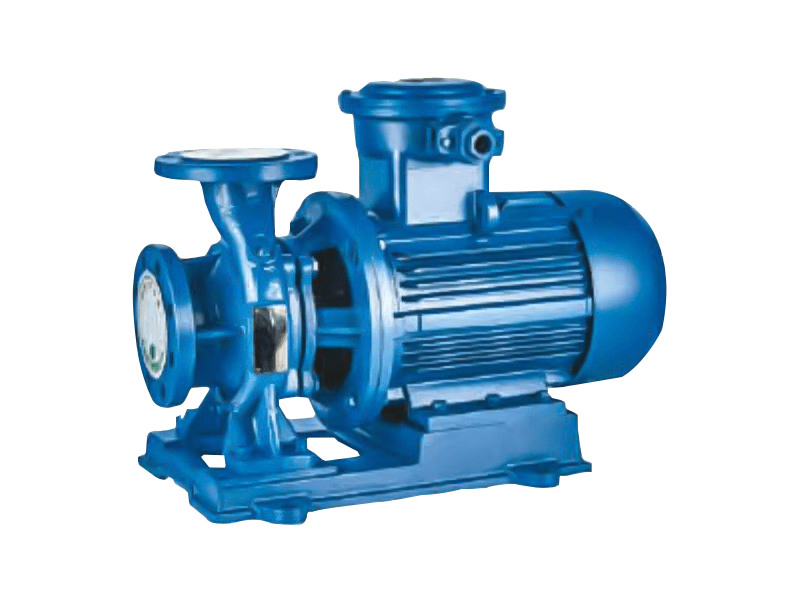
System pressure is another important consideration when specifying a Single Stage Single Pipette Centrifugal Pump. For the listed series, the stated maximum system pressure is 1.6 MPa, calculated from the inlet pressure plus the pump's pressure contribution represented by its head. Projects operating above this limit require separate confirmation before an order is placed.
Liquid properties also affect component selection. The stated conditions limit insoluble suspended solids to 0.1% by volume and particle size to 0.2 mm. Applications involving fine particles may require a wear-resistant mechanical seal, which should be specified during technical communication. These limits matter because abrasive particles can accelerate wear at sealing surfaces and affect long-term maintenance requirements.
Temperature, ambient humidity, altitude, and electrical supply should be checked as part of the same review. The published operating conditions specify an ambient temperature not exceeding 40°C, relative humidity not exceeding 95%, and an altitude not exceeding 1,000 m. Buyers should confirm the correct interpretation of the operating limits and any special requirements with the supplier, particularly for installations outside standard conditions.
Reliable operation depends on the fit and condition of the pump's main components. The casing, impeller, shaft, bearings, and mechanical seal must function as an assembled unit. Dimensional variation, incorrect alignment, or poor sealing contact can contribute to leakage, vibration, or premature component wear. Manufacturing controls should therefore address both individual part quality and the accuracy of final assembly.
For a Single Stage Single Pipette Centrifugal Pump, inspection can include checking machined interfaces, confirming assembly dimensions, and verifying that the motor corresponds to the specified electrical requirements. Operational testing helps identify abnormal noise, vibration, or leakage before shipment. These checks provide useful evidence of assembly condition, although actual performance still depends on the selected model, installation quality, and operating point.
Order documentation also plays a role in consistency. Confirming the model number, rated flow, head, motor power, voltage, frequency, pipe diameter, and working pressure reduces the risk of receiving equipment that does not match the intended system. For repeat orders, retaining the approved specification helps maintain consistency between replacement units and existing installations.
The Single Stage Single Pipette Centrifugal Pump may be considered for compatible water supply, circulation, irrigation, and industrial transfer applications. Its suitability depends on the liquid, system pressure, required flow, and installation conditions. It should not automatically be treated as a solution for abrasive slurry, strongly corrosive media, or any duty outside the stated operating limits.
Before confirming a model, project teams should prepare the required flow rate, total head, inlet pressure, liquid temperature, particle content, power supply, and connection dimensions. Providing these details allows the supplier to evaluate the operating conditions and identify whether a standard configuration is appropriate. The Single Stage Single Pipette Centrifugal Pump should be selected on verified duty requirements, with special sealing or other configuration needs identified before production.
Accurate specification review, controlled component manufacturing, and pre-shipment testing help reduce avoidable selection and assembly problems. For B2B buyers, this process supports clearer technical communication, more predictable installation planning, and better consistency when pumps are supplied for ongoing projects.