


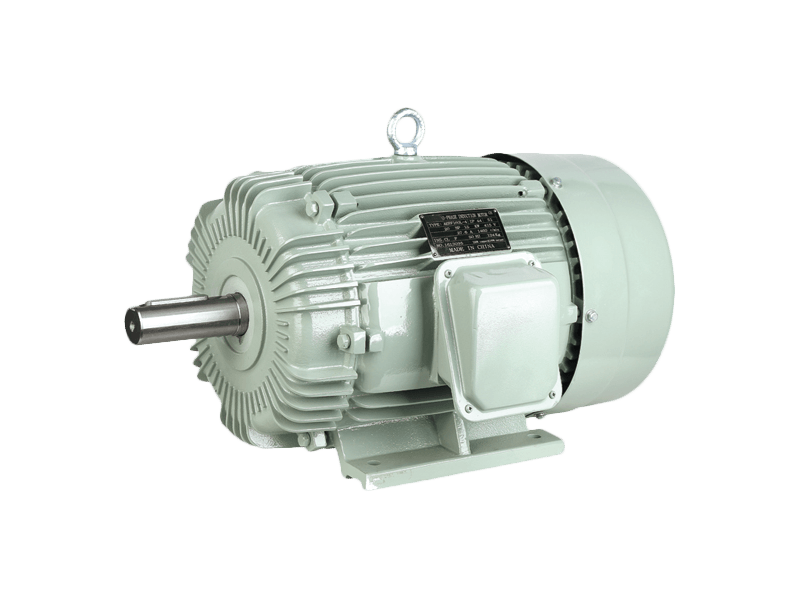
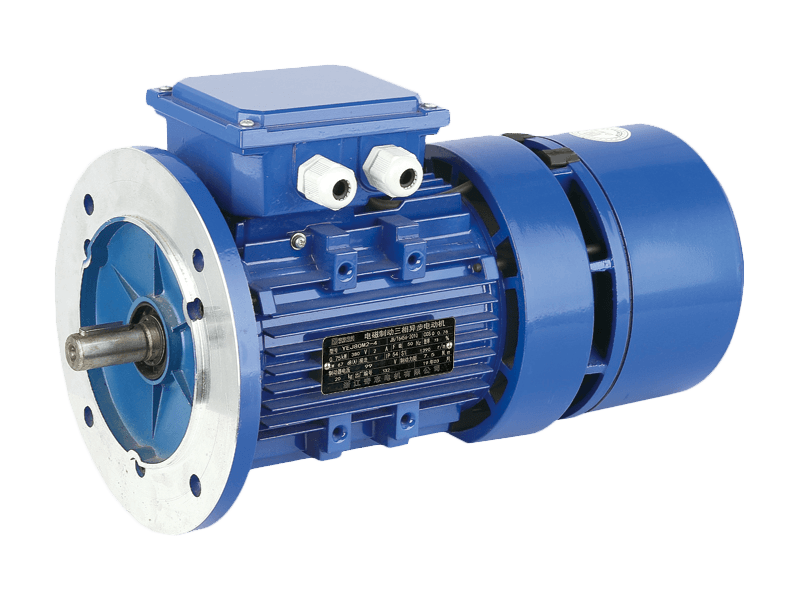
A Multi-Speed Three-Phase Asynchronous Motor changes its running speed by changing the number of stator poles rather than the supply frequency. On a 50 Hz supply, synchronous speed equals 120 times 50 divided by the pole count, so a 2-pole winding runs near 3000 r/min, a 4-pole near 1500, a 6-pole near 1000 and an 8-pole near 750. Zhejiang Qizhi Motor builds this type as the YD series, a derivative of the Y2 range, in double-speed, three-speed and four-speed versions.
The motor moves between set speeds instead of sliding between them, which is why a pole-changing motor suits machines that need a slow step and a fast step rather than a continuous range. Each step has its own nameplate figures. The YD90S in 4/2 pole form is rated at 1430 r/min and 0.85 kW at 4 poles, and 2850 r/min and 1.1 kW at 2 poles. The YD132M shows the same pattern at 6.5 kW and 8 kW. The three-speed YD100L in 6/4/2 form runs at 940, 1420 and 2880 r/min with outputs of 0.75, 1.3 and 1.8 kW. Power factor also changes with the step, from 0.77 at 4 poles to 0.84 at 2 poles on the YD90S, so a multi-speed three-phase asynchronous motor is sized against the rating of the speed where the machine works for the longest time.
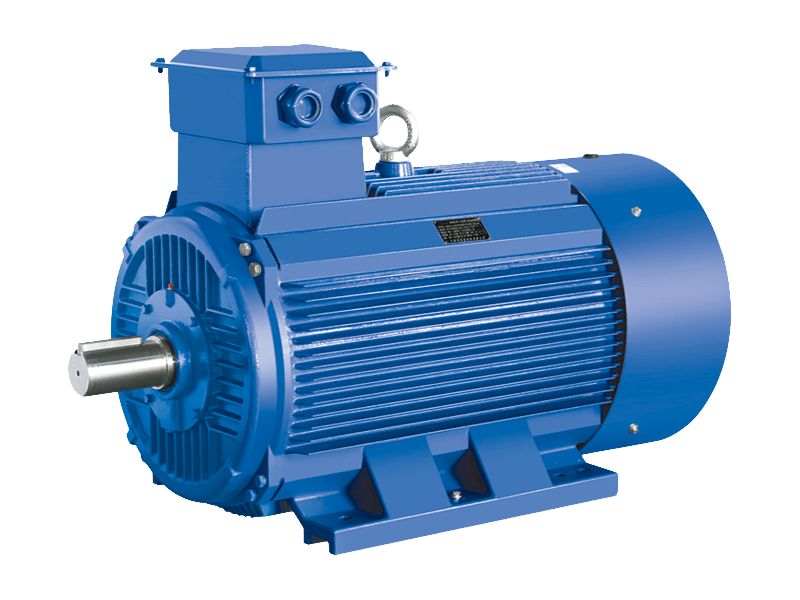
Winding structure explains these differences. In a multi-speed three-phase asynchronous motor, one winding that is reconnected gives a 2:1 speed ratio, such as 4/2 poles. Ratios like 6/4 or 8/6, and three-speed or four-speed combinations such as 6/4/2 or 8/6/4, need more than one winding set in the stator. Winding use differs between these arrangements, and the nameplate output at each speed reflects it.
When a multi-speed three-phase asynchronous motor changes from the high-speed connection to a low-speed one, the rotor briefly turns faster than the new synchronous speed. In that interval the machine acts as an induction generator and produces braking torque until the rotor settles at the lower speed. Heavy fan wheels and loaded conveyor drums carry enough inertia to make this braking visible as a torque step. Control circuits therefore place a short delay between opening one connection and closing the next, and three-speed and four-speed starts usually step through the intermediate speeds in order.
The starting figures in the YD tables show why the high-speed connection needs attention at start-up. In the 4/2 versions, locked-rotor current is 6.5 times rated current at 4 poles and 7 times at 2 poles, with locked torque of 1.5 and 1.6 times rated torque. Maximum torque is 1.8 times rated torque at both speeds, which gives the same overload margin whichever step is running.
A multi-speed three-phase asynchronous motor can simplify a mechanical drive line or take the place of a reduction gearbox where the machine needs stepped speeds. It is used in food processing, beer and beverage lines, petrochemical plants, warehousing and logistics, and lifting and transport equipment. A bottle conveyor can run at a slow step while containers accumulate and a fast step while the line clears. A sorting conveyor can use a slow step for positioning and a fast step for travel. Hoisting and traveling mechanisms use the same split between approach speed and working speed. Where a drive line once used a gearbox to produce a second speed, the pole change produces it in the winding itself, so the shaft runs at both speeds with no gear stage between motor and load.
The YD series covers frame sizes from 80 to 280 with protection class IP44. It is rated for 380 V within plus or minus 5 percent, ambient temperatures from minus 15 to 40 degrees Celsius and altitudes up to 1000 m. A pole-changing motor used inside those conditions drives its load directly at each step, and a Multi-Speed Three-Phase Asynchronous Motor from the YD range is matched to the machine by choosing the pole combination and frame size that fit the speed pair it requires.
 中文简体
 русский
 Español
