


A plant replaces a fan's 3 Phase Asynchronous Motor with a higher-efficiency unit, expecting the electricity bill to drop. Instead the airflow goes up, the ammeter reads higher, and the bill barely moves. Nothing is wrong with the new motor. The cause is a number that sits on every nameplate and gets less attention than kW: rated speed.
An induction rotor always turns slightly slower than the rotating field in the stator, and the gap is called slip. On a 3 Phase Asynchronous Motor with four poles on a 50 Hz supply, the field speed is 1500 rpm. A standard-efficiency unit might run at around 1460 rpm under load, while a higher-efficiency design, which cuts losses partly by using more conductor in the rotor, may run at around 1480 rpm in the same frame size. The difference looks small: 20 rpm, or about 1.4 percent. These figures are examples only, since slip varies by power rating and by maker, and the nameplate is the only number to trust.
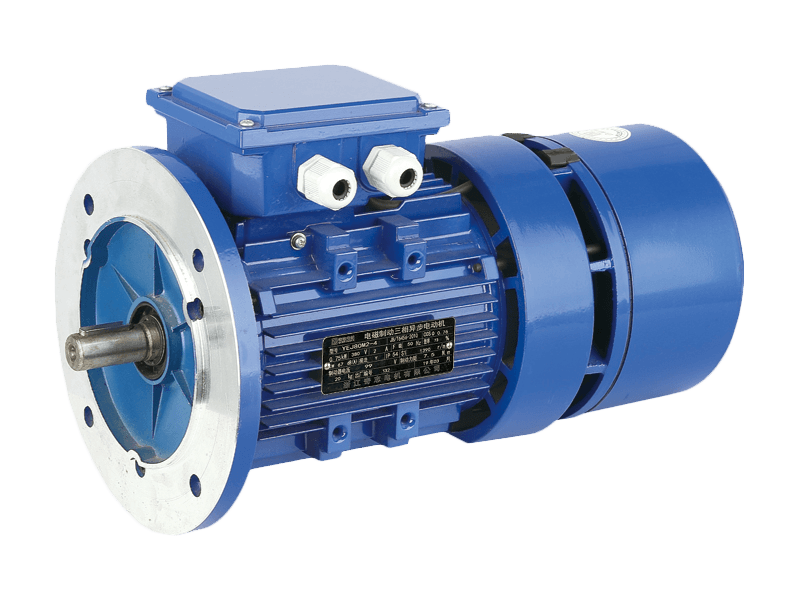
For a centrifugal fan or pump, power demand follows the cube of speed. Raise the speed by 1.4 percent and shaft power rises by about 4 percent, because 1.014 cubed is roughly 1.042. If the efficiency gain between the two motors is two or three percentage points, that extra power can cancel the saving. When a 3 Phase Asynchronous Motor drives a fan through a direct coupling, there is no belt ratio or gearbox to absorb the change, so the fan simply spins faster and moves more air than the process needed.
Fans and centrifugal pumps are the sensitive cases. Conveyors and positive displacement pumps run closer to constant torque, so power rises roughly in step with speed and the machine delivers a little more throughput. Compressors sit somewhere between, depending on the control method. A reducer adds another layer, since a slightly faster input shaft means a slightly faster output. Knowing what sits behind the motor tells an engineer whether the speed difference is a footnote or a problem. A 3 Phase Asynchronous Motor on a constant-torque conveyor sees only a small throughput gain, while the same motor on a ventilation fan can change the whole energy picture.
Three adjustments are common after a 3 Phase Asynchronous Motor swap. The first is to trim the impeller diameter or change the pulley ratio so the driven machine returns to its old speed. The second is to add a variable frequency drive and set the frequency to match the old operating point, which also leaves room to run lower when demand falls. The third is to check the old operating point itself: some systems were slightly undersized for their duty, and the extra speed fixes a long-standing shortfall. Measuring input kW before and after a swap is more telling than comparing efficiency classes on paper. For a 3 Phase Asynchronous Motor running 6,000 hours a year, that check is a short job set against a long-running bill.
Rated speed in rpm at full load, rated current, and efficiency at 75 and 100 percent load belong together on the datasheet. Panel builders and importers who pass motors on to machine makers often receive only kW and an efficiency class, and the speed question arrives later from the customer. A 3 Phase Asynchronous Motor that ships with a one-page sheet showing those four numbers answers it in advance. For fan and pump makers who publish a speed and torque curve in their own manuals, the same data lets them confirm the match without a test run.
Efficiency class tells how little energy a motor wastes inside itself. It does not tell what the driven machine will do with a slightly faster shaft. A 3 Phase Asynchronous Motor chosen with both questions in mind saves what the class promises.
 中文简体
 русский
 Español
